Protecting Your Eyes in the Sun: UV, Blue Light and Simple Habits Outdoors
How sunlight affects your eyes over the years, what to look for in sunglasses, why a hat helps, and what science says about blue light.
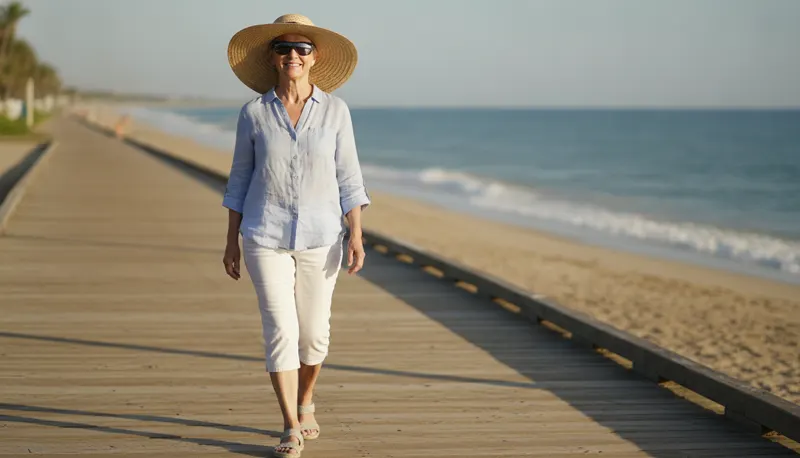
A morning walk, an afternoon in the garden, a day at the beach. Time outdoors is good for body and mind.
Most of us remember sunscreen for our skin. It's just as important to protect our eyes. The good news is that it's easy, and it doesn't have to cost much.
How the sun affects your eyes
Sunlight contains ultraviolet (UV) rays. You can't see or feel them, but over many years they add up.
The American Academy of Ophthalmology explains that UV light can damage the surface of the eye, as well as the cornea and the lens. Too much exposure raises the risk of eye problems, including:
- Cataracts, a clouding of the eye's lens
- Pterygium, a fleshy growth on the white of the eye
- Photokeratitis, a painful "sunburn" of the eye surface, often from sun reflecting off snow, sand or water
- Some eye cancers
The World Health Organization estimates that worldwide, about 10% of blindness from cataracts may be related to UV exposure. It also notes UV may play a role in age-related macular degeneration.
When UV is strongest
According to the American Academy of Ophthalmology and the World Health Organization:
- Sunlight is strongest from midday to early afternoon.
- Clouds don't block UV. The rays pass through haze and clouds.
- Water, sand and snow reflect UV, so you get more exposure at the beach, by a lake or in winter.
- UV is stronger at higher altitudes.
So sunglasses aren't just for bright summer days. They're helpful all year.
How to choose sunglasses that protect
Check the label for UV protection
This is the most important step. Look for a label that says 100% UV protection or UV400. The National Eye Institute recommends sunglasses that block 99 to 100 percent of both UVA and UVB rays.
Darker isn't always better
The American Academy of Ophthalmology explains that a darker lens doesn't mean more protection. Only the UV rating tells you that.
Polarized lenses reduce glare, not UV
Polarized lenses can make driving or being near water more comfortable by cutting glare. But polarization alone doesn't block UV. Check that the label also says 100% UV protection.
Bigger and wraparound styles help
Larger lenses and wraparound frames keep sunlight from sneaking in at the sides.
Protection doesn't need to be expensive
The Academy notes that inexpensive sunglasses labeled 100% UV-blocking are a better choice than costly ones without UV protection.
Add a hat
A broad-brimmed hat shades your eyes from above. The American Academy of Ophthalmology recommends wearing one along with your sunglasses. The World Health Organization also recommends a broad-brimmed hat to protect the eyes, face, ears and neck.
The wider the brim, the more shade it gives your eyes and face.
Never look straight at the sun
Looking directly at the sun, even for a short time or during an eclipse, can injure the retina. The American Academy of Ophthalmology warns that this can cause a serious injury called solar retinopathy.
Extra care if you've had cataract surgery
During cataract surgery, the eye's natural lens is replaced with an artificial one. The American Academy of Ophthalmology says that if your new lens is not the UV-absorbing type, it is especially important to wear sunglasses and a hat outdoors. Ask your eye doctor which kind you have.
Some medicines can also make your eyes more sensitive to light. If you take one, ask your doctor about extra precautions.
What about blue light?
Blue light is part of normal sunlight. You may have heard worries about blue light from phones and computers.
The American Academy of Ophthalmology says:
- The largest source of blue light is the sun, not screens.
- There is no scientific evidence that blue light from screens damages the eyes.
- The Academy does not recommend special blue light-blocking glasses for computer use.
What we do know is that UV light raises the risk of eye disease. So your outdoor sunglasses and hat are the protection that matters most.
Sunlight has good sides, too
Daylight helps set your body clock and supports good sleep. The American Academy of Ophthalmology notes that a little natural light every day helps us sleep well, which matters more as we age.
So keep enjoying the outdoors. Just bring your eye protection along.
A simple outdoor checklist
- Sunglasses labeled 100% UV or UV400
- A wide-brimmed hat
- Extra care at midday, near water and on snow
- Sunglasses on cloudy days, too
- Never look directly at the sun
When to talk to your eye doctor
Please see your eye doctor if:
- Your eyes become painful, red or very sensitive to light after time in the sun.
- You notice a growth or bump on the white of your eye.
- You've had cataract surgery and aren't sure if your lens blocks UV.
- You take a medicine that makes you sensitive to sunlight.
- Glare outdoors is getting harder to handle. This can be a sign of cataracts.
Your eye doctor can also check your eyes during a regular dilated eye exam.
Sources
- The Sun, UV Light and Your Eyes, American Academy of Ophthalmology
- How to Choose the Best Sunglasses to Avoid Sun Damage, American Academy of Ophthalmology
- How Can UV Light Damage Your Eyes?, American Academy of Ophthalmology
- Should You Be Worried About Blue Light?, American Academy of Ophthalmology
- Ultraviolet Radiation, World Health Organization
- Keep Your Eyes Healthy, National Eye Institute